
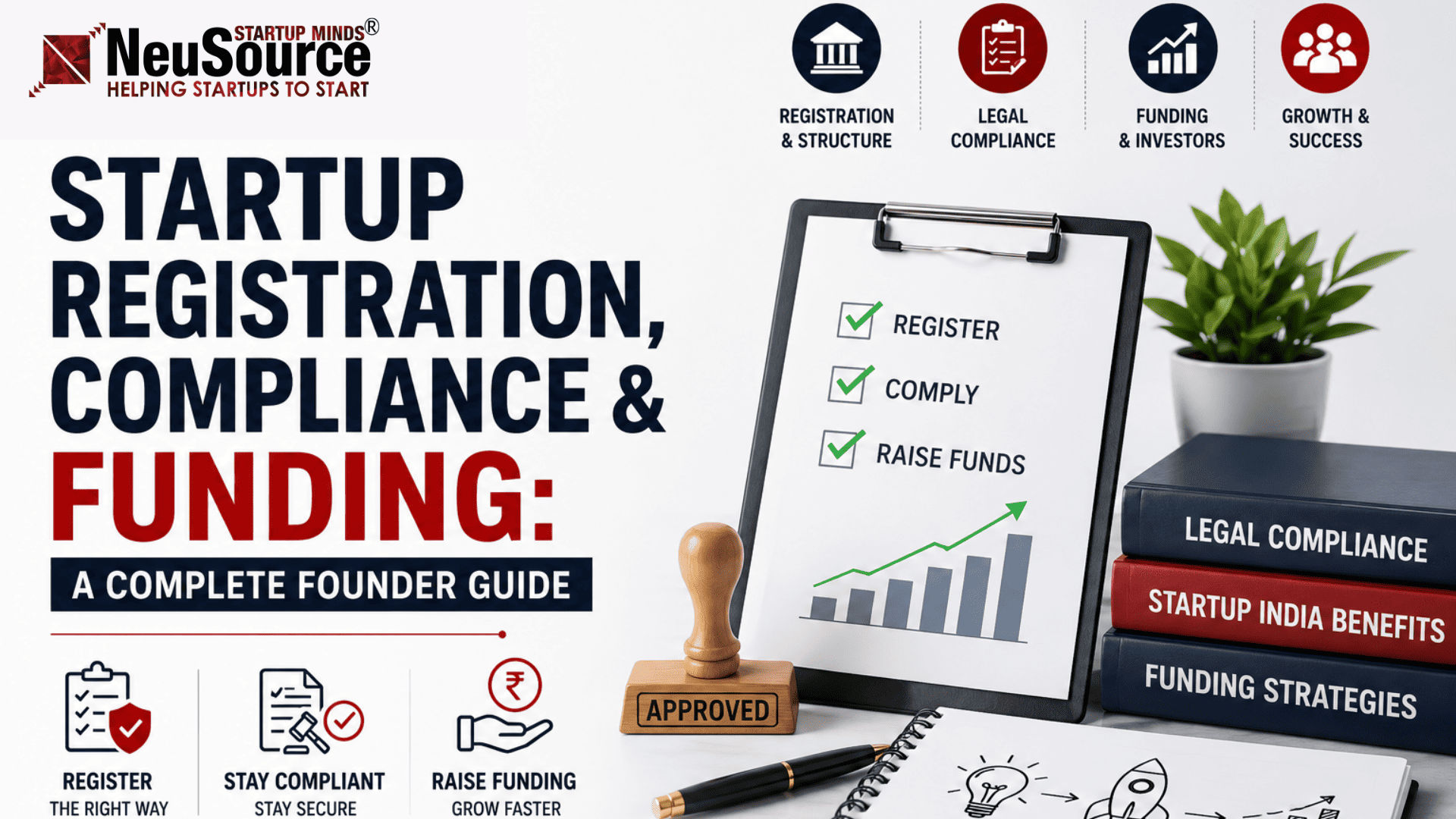
Every successful startup begins with a great idea, but transforming that idea into a sustainable business requires much more than innovation. Before attracting customers, raising investment, or scaling operations, founders must establish a strong legal, financial, and operational foundation.
For many entrepreneurs, navigating business registration, regulatory compliance, and fundraising can feel overwhelming. Questions such as Which business structure should I choose?, What compliances are mandatory?, When should I raise funding?, and How do investors evaluate startups? are common among first-time founders.
Ignoring these fundamentals can lead to legal complications, financial penalties, difficulty attracting investors, and slower business growth.
This comprehensive founder guide explains everything entrepreneurs need to know about startup registration, legal compliance, and funding in India. It will help founders build legally secure, financially disciplined, and investor-ready businesses while avoiding common mistakes.
Many entrepreneurs initially operate as freelancers, independent professionals, or informal businesses. While this approach may work during the early testing stage, it creates limitations when the business begins to grow.
A properly registered startup receives legal recognition and establishes a formal identity in the market. It also makes it easier to open a business bank account, enter into contracts, hire employees, apply for government schemes, and approach investors.
Some of the major benefits of startup registration include:
Investors, institutional clients, and large companies generally prefer working with legally registered businesses because registration reflects professionalism, accountability, and long-term commitment.
Selecting the correct legal entity is one of the most important decisions a founder will make. The right structure depends on the number of founders, business activities, funding plans, liability concerns, taxation, and long-term growth objectives.
A sole proprietorship is suitable for individuals starting a small business with limited investment and simple operations. It is easy to establish and involves fewer compliance requirements.
However, there is no legal separation between the owner and the business. The proprietor may therefore be personally responsible for business debts and liabilities.
A partnership firm is suitable when two or more individuals want to operate a business together and share responsibilities, profits, and losses.
Founders should prepare a properly drafted partnership deed to define capital contribution, profit-sharing ratio, duties, authority, dispute resolution, and exit terms.
A Limited Liability Partnership, commonly known as an LLP, combines the operational flexibility of a partnership with limited liability protection.
An LLP has a separate legal identity and is often preferred by professional service businesses that do not immediately require equity investment from venture capital firms.
A Private Limited Company is one of the most preferred structures for startups planning to raise external investment, issue equity, build a scalable business model, or expand rapidly.
Most angel investors, venture capital firms, accelerators, and institutional investors prefer investing in Private Limited Companies because the ownership and equity structure is clearly defined.
The startup registration process depends on the type of entity chosen. However, the overall journey generally involves the following steps.
Founders should compare different structures based on compliance requirements, taxation, liability, ownership, fundraising plans, and operational flexibility.
The proposed business name should be distinctive and should not closely resemble an existing company, LLP, or registered trademark. Founders should also check domain-name and social-media availability before finalizing the brand.
Documents commonly required may include:
Depending on the chosen entity, incorporation applications are submitted to the relevant authority. After approval, the business receives its registration or incorporation certificate.
A dedicated current account helps founders separate personal and business transactions. This improves accounting accuracy, financial discipline, taxation, and investor transparency.
After incorporating an eligible entity, founders may apply for recognition under the Startup India initiative.
Startup India recognition is different from company incorporation. A business must first be legally registered before applying for recognition.
Founders should carefully verify the eligibility requirements and understand that recognition does not automatically guarantee tax exemption, grants, or funding.
Incorporation alone may not be sufficient. Additional registrations may be required depending on the startup's activities, turnover, location, employee strength, and industry.
PAN is required for taxation and financial transactions, while TAN may be required when the business is responsible for deducting tax at source.
GST registration may be mandatory when the business crosses the applicable turnover threshold or undertakes activities that require compulsory registration.
Eligible businesses may register under the MSME framework to access certain government benefits, schemes, delayed-payment protections, and business opportunities.
Startups involved in the import or export of goods may require an Import Export Code.
Depending on the state and nature of operations, businesses may need to register under the applicable Shops and Establishment law.
Employee-related registrations may become mandatory when the startup reaches the applicable employee threshold or falls under specific legal provisions.
Trademark registration helps founders protect their brand name, logo, tagline, and product identity from unauthorized use.
Business registration is only the beginning. Every registered startup must meet ongoing legal, tax, accounting, and regulatory obligations.
Startup compliance generally includes maintaining records, filing returns, paying taxes, conducting required meetings, managing employee documentation, and reporting important business changes.
Failure to comply may result in:
Strong compliance is not merely a legal obligation. It is an important indicator of business discipline and governance.
Companies registered under the Companies Act are required to file prescribed forms and documents with the Registrar of Companies.
Common requirements may include:
LLPs are also required to maintain proper accounts and submit applicable annual returns and financial information.
GST-registered businesses must issue proper invoices, maintain transaction records, reconcile data, and file applicable returns on time.
In certain cases, returns may still be required even where there is no business activity during the filing period.
Startups may be required to:
Startups employing staff should maintain proper employment contracts, payroll records, attendance systems, leave policies, confidentiality clauses, and employee benefit documentation.
Depending on applicability, labour-related compliance may include:
Many startups begin with trust between friends, colleagues, or family members. However, verbal understanding is not sufficient when ownership, money, responsibilities, and future decisions are involved.
A founder or shareholder agreement should clearly address:
Proper agreements reduce uncertainty and protect the startup when disagreements arise.
A startup's intellectual property may become one of its most valuable assets. Investors often evaluate whether the business owns and controls the technology, brand, content, and innovation on which its growth depends.
Founders should consider protecting:
Depending on the nature of the asset, protection may involve trademarks, copyrights, patents, design registration, confidentiality agreements, and intellectual property assignment agreements.
Investors rarely fund ideas alone. They evaluate the quality of the team, market opportunity, business model, execution capability, financial discipline, and growth potential.
Important investor-readiness factors include:
Investor readiness should begin long before a founder starts sending pitch decks. Clean records, compliance discipline, and a well-organized data room can significantly improve fundraising outcomes.
Startups raise capital at different stages depending on product maturity, customer traction, revenue, and expansion plans.
Bootstrapping means building the startup using the founders' own savings or business-generated revenue.
However, limited capital may slow product development, hiring, and market expansion.
Many startups receive initial capital from family members, friends, or professional contacts.
Even when funding comes from trusted relationships, founders should document the transaction properly and clarify whether it is a loan, gift, equity investment, or convertible instrument.
Angel investors typically invest in early-stage startups with promising founders, market opportunities, and growth potential.
In addition to capital, angel investors may provide:
Seed capital is generally used to build the product, strengthen the team, acquire early customers, validate the business model, and prepare the startup for growth.
Venture capital firms usually invest in startups with scalable models, strong market potential, meaningful traction, and the ability to deliver rapid growth.
VC investors generally conduct detailed commercial, financial, legal, and technical due diligence before investing.
Startups may also explore loans, credit facilities, venture debt, or government-supported financing. Debt may help founders raise capital without immediate equity dilution, but it creates repayment obligations.
Eligible startups may explore grants, incubator support, innovation programs, seed-fund schemes, and state-level initiatives.
Founders should carefully review eligibility criteria, application requirements, and fund-utilization conditions.
Raising funds too early can result in unnecessary dilution, while raising too late can restrict growth and create financial stress.
A startup may consider raising external capital when it has:
Funding should be connected to specific growth milestones such as product development, geographic expansion, hiring, technology investment, or customer acquisition.
Founders should organize all essential information before approaching investors.
A startup pitch deck should explain:
Financial projections should be based on reasonable assumptions rather than unrealistic growth expectations.
Founders should understand:
A capitalization table, or cap table, shows the startup's ownership structure. It includes founders, investors, employee stock options, and other security holders.
An inaccurate or overly complicated cap table can create serious issues during fundraising.
A well-organized investor data room may include:
Investors evaluate both the startup's potential and its risks.
Common evaluation factors include:
Founders should be prepared to support every major claim with evidence, data, customer feedback, contracts, or financial information.
Startup valuation determines the estimated value of the business during fundraising. It influences how much equity the founder must offer in exchange for investment.
A higher valuation may reduce immediate dilution, but an unrealistic valuation can discourage investors and create problems during future funding rounds.
Founders should understand the difference between pre-money and post-money valuation and carefully evaluate how each funding round affects ownership and control.
Equity dilution is not always negative. Giving up a reasonable percentage to the right investor may help the startup access capital, mentorship, networks, governance support, and faster growth.
Many startups face unnecessary problems because legal, financial, and fundraising matters are delayed or handled informally.
Common mistakes include:
Avoiding these mistakes can improve operational stability, investor confidence, and long-term startup success.
Building a startup involves more than company registration and funding. Founders also need access to knowledge, professional networks, mentors, investors, and opportunities to present their businesses.
NeuSource World brings together founders, mentors, investors, professionals, incubators, and other members of the startup ecosystem to support entrepreneurial growth.
Through initiatives such as The Founders Meet, entrepreneurs can build meaningful professional connections and interact with other startup founders. The Founder Show gives selected startups an opportunity to present their business ideas, while Founder Bootcamp helps entrepreneurs strengthen core business fundamentals. The Founders Talk offers practical insights from founders and industry professionals.
When combined with proper registration, disciplined compliance, strong documentation, and a well-planned funding strategy, ecosystem participation can help startups improve credibility and accelerate sustainable growth.
A successful startup is built on more than a promising idea. The right business structure, timely registration, legal compliance, financial discipline, intellectual property protection, and strategic fundraising create the foundation required for sustainable growth.
Founders who establish proper systems from the beginning are better prepared to attract customers, hire employees, work with institutional clients, and complete investor due diligence.
As India's startup ecosystem continues to expand, legally compliant and investor-ready businesses will be in a stronger position to earn market trust, raise capital, and scale confidently.
The most effective approach is simple: register correctly, remain compliant, maintain accurate records, protect valuable assets, and raise funds with a clear purpose.