
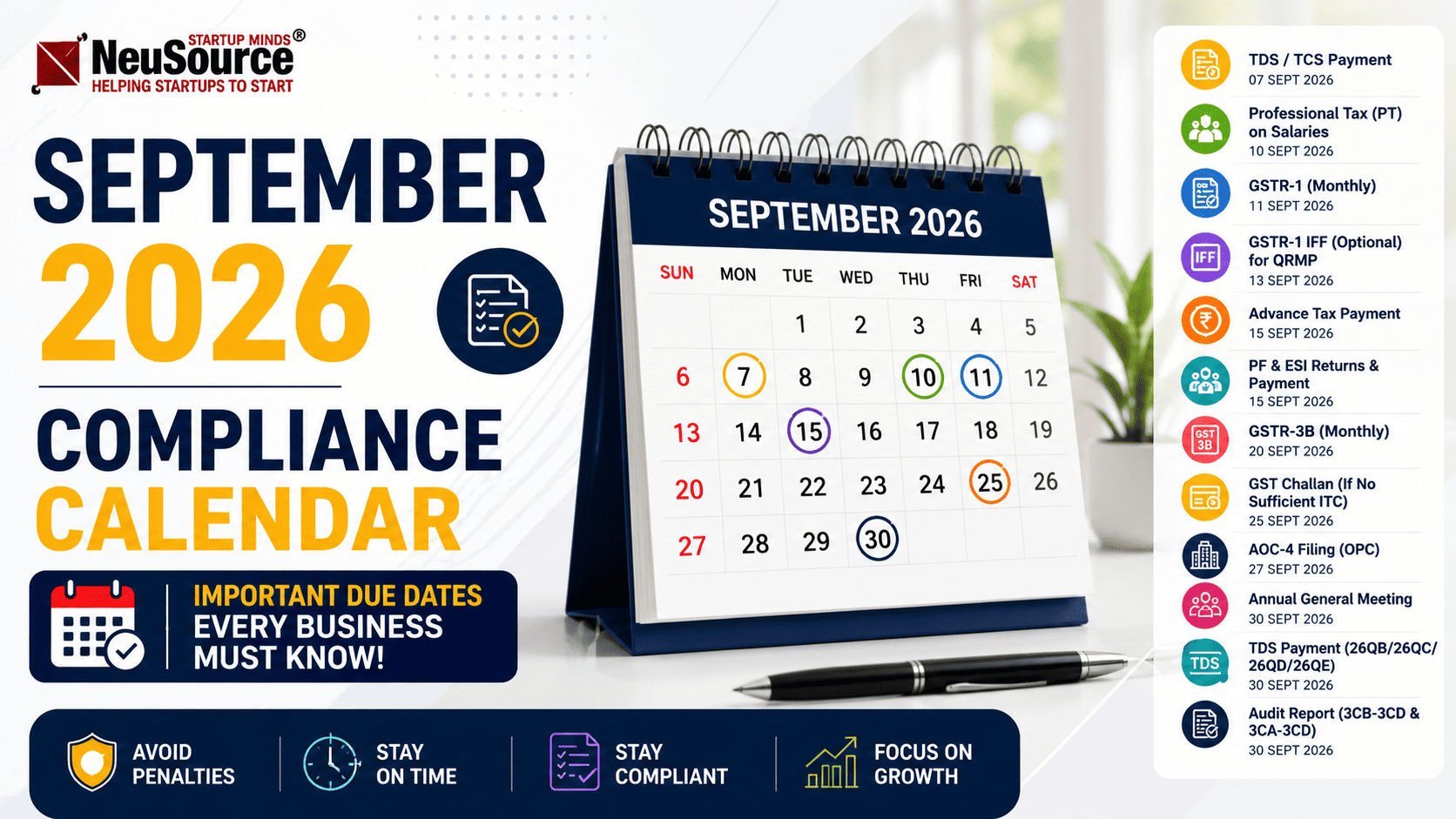
September is an important compliance month for businesses, companies, startups, employers and taxpayers in India. Several GST returns, TDS payments, advance tax instalments, payroll-related compliances, ROC filings and tax audit requirements fall due during the month.
Missing a statutory deadline can result in interest, late fees, additional filing costs and, in some cases, other consequences. A well-maintained compliance calendar for September 2026 helps businesses track their obligations in advance instead of dealing with last-minute filings.
Below is a practical overview of the major September 2026 compliance deadlines.
Businesses and other deductors required to deposit TDS generally need to deposit tax deducted during August 2026 by 7 September 2026, subject to the applicable rules and exceptions.
TDS compliance is particularly important for businesses making payments such as:
Businesses should reconcile their TDS deductions with their books of accounts and ensure that the correct amount is deposited on time.
Employers covered under applicable Professional Tax (PT) laws should deposit the professional tax deducted from employees' salaries for August 2026.
However, Professional Tax is a state-specific compliance. The applicable rate, registration requirement, return requirement and due date can differ from one state to another.
Therefore, businesses should not blindly apply 10 September as a universal Professional Tax deadline. The applicable state legislation and registration conditions should be checked before filing or payment.
Monthly GST taxpayers generally need to file GSTR-1 for August 2026 by 11 September 2026.
GSTR-1 contains details of outward supplies, including relevant:
Before filing GSTR-1, businesses should reconcile:
Errors in GSTR-1 can affect the recipient's input tax credit and may create unnecessary reconciliation issues.
Eligible taxpayers using the QRMP (Quarterly Return Monthly Payment) Scheme may use the Invoice Furnishing Facility (IFF) for the relevant month.
For August 2026, the IFF deadline is 13 September 2026, where applicable.
IFF is particularly useful for QRMP taxpayers who want to make eligible invoice details available to recipients during the quarter rather than waiting for the quarterly GSTR-1 filing.
15 September 2026 is an important income-tax deadline because it marks the second advance-tax instalment for FY 2026-27.
Eligible taxpayers generally need to pay advance tax when their estimated tax liability meets the prescribed threshold after considering applicable credits such as TDS.
The second instalment falls due on 15 September and brings cumulative advance-tax payment to the prescribed 45% level.
Advance tax may be relevant for:
Taxpayers should estimate their income and tax liability instead of waiting until the end of the financial year.
Employers covered under applicable Provident Fund (PF) and Employee State Insurance (ESI) requirements need to complete their monthly payroll-related compliance for August 2026.
PF contributions are generally required to be remitted by the 15th of the following month.
Employers should ensure that employee deductions, employer contributions, wage records and payment records are properly reconciled.
For ESI, employers should also check the applicable statutory payment timeline and current ESIC requirements before filing or paying.
Monthly GST taxpayers generally need to file GSTR-3B for August 2026 by 20 September 2026.
GSTR-3B is a summary GST return used to declare GST liabilities and discharge the applicable tax liability.
Before filing, businesses should reconcile:
A mistake in GSTR-3B can directly affect the amount of GST paid and the input tax credit claimed. Proper reconciliation before filing is therefore essential.
Taxpayers under the QRMP Scheme generally make monthly tax payments for the first two months of a quarter through Form GST PMT-06.
For August 2026, the relevant payment deadline is 25 September 2026, subject to the applicable QRMP rules.
The QRMP framework allows eligible taxpayers to file returns quarterly while making monthly tax payments during the first two months of the quarter.
Businesses should calculate their estimated monthly GST liability carefully and ensure sufficient funds are available for timely payment.
For an One Person Company (OPC) with a financial year ending on 31 March 2026, the September compliance calendar includes the AOC-4 filing deadline.
AOC-4 is used for filing financial statements and related documents with the Registrar of Companies.
For OPCs, the applicable filing timeline differs from the standard timeline applicable to companies holding an AGM. Therefore, companies should verify their specific statutory position before filing.
The AOC-4 filing should generally be prepared using the company's approved financial statements and supporting documents.
Before filing, ensure that:
30 September 2026 is a key date for companies whose statutory AGM deadline falls on that date.
An AGM is an important corporate compliance requirement through which shareholders consider matters such as:
However, 30 September should not be treated as the universal AGM deadline for every company. The applicable deadline depends on the company's circumstances and statutory requirements, including whether it is holding its first AGM.
Companies should therefore review their individual AGM timeline rather than assuming that every entity must hold its AGM on 30 September.
For applicable taxpayers whose tax audit report for FY 2025-26 falls due in September, 30 September 2026 is an important deadline.
For FY 2025-26, applicable tax audit reports use the prescribed tax audit forms and related reporting requirements. Taxpayers subject to tax audit should coordinate with their Chartered Accountant well before the deadline.
The audit process may require:
Waiting until the final few days can create unnecessary pressure and increase the risk of errors.
Your September 2026 compliance calendar may also include challan-cum-statement requirements relating to specified transactions, such as:
For transactions governed by the Income-tax Act, 2025 from 1 April 2026 onward, the earlier Forms 26QB, 26QC, 26QD and 26QE have been consolidated into Form 141 for the specified categories of transactions.
Therefore, businesses and taxpayers should not automatically continue using the older form numbers for post-1 April 2026 transactions.
For August 2026 transactions falling under the new framework, the applicable Form 141 requirements should be checked.
A compliance calendar is useful only when it is converted into an action plan.
Compliance should not be managed only when a deadline is approaching.
Important filings are visible well in advance.
Timely payments can help avoid unnecessary financial consequences.
Tax and statutory payments can be incorporated into monthly cash-flow planning.
Teams have sufficient time to reconcile data before submission.
A systematic compliance process creates an organized audit trail.
For companies and startups, timely statutory compliance contributes to better governance and record management.
September 2026 is a high-activity compliance month for Indian businesses, with important deadlines across GST, income tax, payroll, ROC and audit-related requirements.
From GSTR-1 and GSTR-3B to advance tax, TDS, PF, ESI, AOC-4, AGM and tax audit, businesses need to track multiple obligations simultaneously.
The biggest compliance mistake is not necessarily missing a deadline. It is assuming that a deadline applies—or does not apply—without checking the entity's specific circumstances.
A structured September 2026 compliance calendar helps founders, business owners, accountants and finance teams plan payments, reconcile records and complete statutory filings on time.
For best results, maintain your compliance calendar throughout the year rather than preparing it only when deadlines are close.