
Many founders believe fundraising begins when they start contacting investors. In reality, fundraising begins much earlier.
It begins when a startup builds clean financial records, validates customer demand, protects its intellectual property, organizes legal documents, improves its pitch, and prepares clear answers to difficult investor questions.
An investor-ready startup is not simply one with a good idea. It is a startup that can prove its potential with data, structure, discipline, and a realistic growth plan.
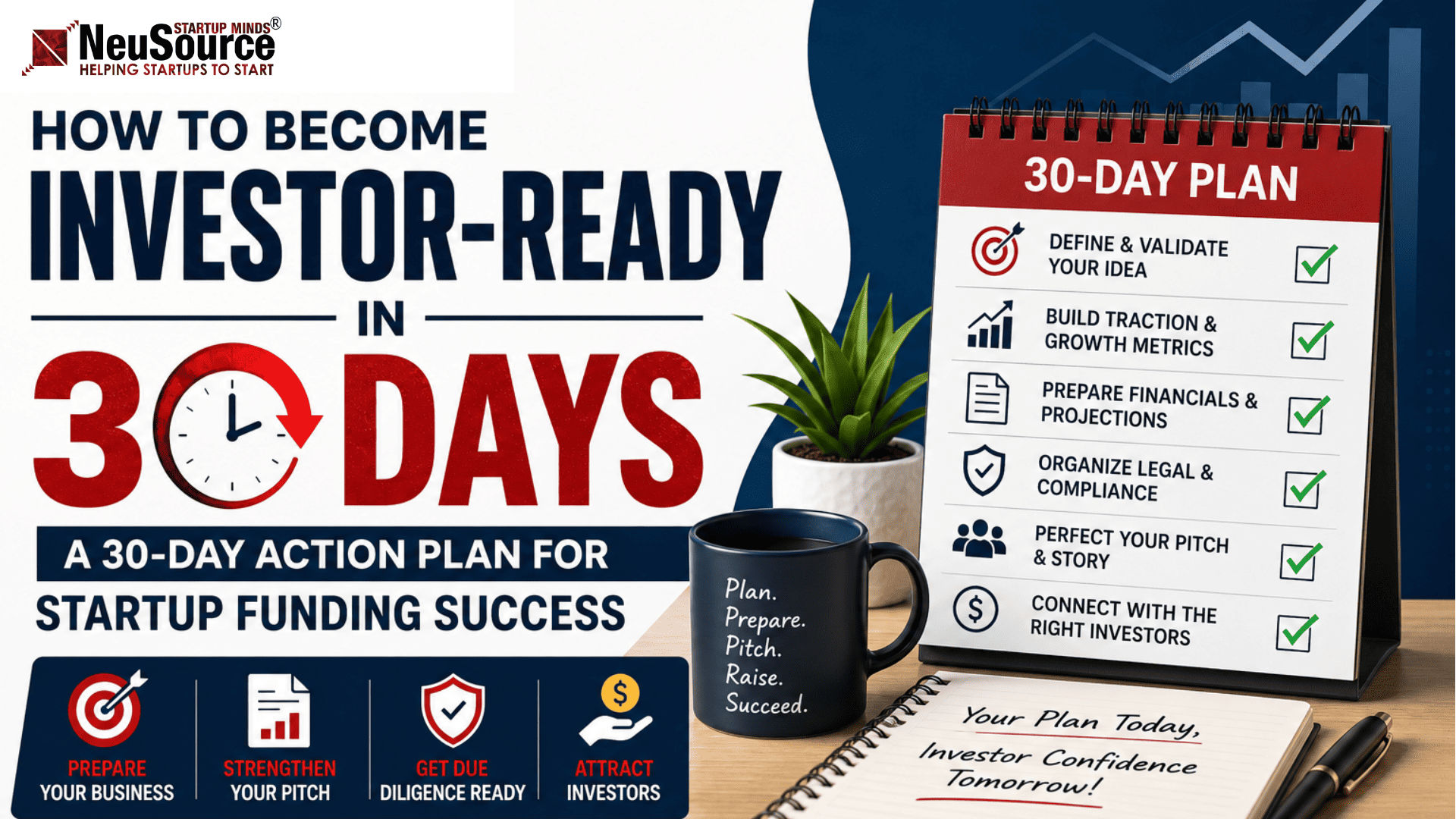
For early-stage founders, becoming investor-ready may feel like a long and complicated process. However, with focused execution, it is possible to make meaningful progress within 30 days.
This guide presents a practical, week-by-week roadmap to help founders improve their pitch deck, financial projections, legal compliance, startup valuation, traction story, and investor communication.
The goal is not to guarantee funding within 30 days. The goal is to ensure that when you meet an investor, your startup looks prepared, credible, and worthy of serious consideration.
An investor-ready startup is prepared to answer the questions investors are likely to ask before making a funding decision.
These questions generally include:
A startup becomes investor-ready when the answers to these questions are clear, consistent, evidence-based, and supported by properly organized documents.
Investors do not evaluate startups only on ideas. They evaluate risk.
Every missing document, unclear financial number, inconsistent claim, or unresolved legal issue increases perceived risk.
A strong investor-readiness process helps founders:
Being prepared also saves time. Instead of searching for documents after an investor asks for them, founders can share the required information quickly and professionally.
The 30-day roadmap is divided into four practical stages:
Each stage addresses a different part of investor readiness.
Your startup should solve a specific and meaningful problem.
Avoid broad statements such as:
“We want to transform the industry.”
Instead, explain:
A strong problem statement is specific, measurable, and easy to understand.
For example:
Small retailers struggle to track inventory accurately, resulting in stock shortages, excess purchases, and lost sales.
This is more effective than saying:
Retail inventory management is difficult.
The sharper the problem statement, the easier it becomes for investors to understand the opportunity.
A startup that tries to serve everyone usually struggles to attract anyone.
Define your ideal customer using factors such as:
For a B2B startup, identify whether your buyer is the founder, HR manager, finance head, hospital administrator, retailer, or enterprise procurement team.
For a B2C startup, understand the customer's lifestyle, priorities, spending ability, and purchase motivation.
Investors want to know whether you understand exactly who will buy your product.
Investors want evidence that the market is large enough to support meaningful growth.
The overall demand for your product or service if you captured the entire market.
The segment of the total market your startup can realistically serve.
The portion of the market you can reasonably capture within a defined period.
Avoid using large industry numbers without explaining how they relate to your business.
A credible market analysis should connect the broader market to your customer segment, location, pricing, and distribution strategy.
Your business model explains how the startup makes money.
Common startup revenue models include:
Investors will want to understand:
A strong revenue model should be simple enough to explain in one or two sentences.
Investors will ask why customers should choose your startup over existing alternatives.
Your competitive advantage may come from:
Avoid saying that you have no competition. Every startup has direct or indirect competition.
Instead, show that you understand the competitive landscape and explain why your approach is more attractive.
Traction is one of the strongest indicators of startup potential.
Depending on the stage of the business, traction may include:
Pre-revenue startups should focus on validation, pilots, user feedback, product testing, or early demand signals.
Do not inflate numbers. Investors generally identify inconsistencies quickly.
Define the milestones you want to achieve during the next 12 months.
These may include:
Your funding requirement should be connected to these milestones.
Investors are more interested in startups that know exactly what the next round of capital will help them achieve.
A strong investor pitch is not a collection of random facts. It is a clear story.
The story should explain:
Each section should lead naturally to the next.
The investor should understand not only what your startup does, but why it can become a scalable business.
Your elevator pitch should explain the business in 30 to 60 seconds.
A simple format is:
We help [target customer] solve [specific problem] through [solution]. Unlike [existing alternative], our approach provides [key advantage]. We currently have [traction], and we are raising [funding amount] to achieve [next milestone].
Practice until the pitch sounds natural rather than memorized.
A standard investor pitch deck usually includes:
Avoid overcrowding slides with excessive text.
Use charts, numbers, customer data, product screenshots, and clear headlines to communicate important information quickly.
The problem and solution slides are among the most important parts of the deck.
The problem slide should show:
The solution slide should show:
Do not describe features without connecting them to customer value.
The traction slide should display the strongest proof that the startup is progressing.
Possible data points include:
Present traction visually through graphs, timelines, or milestone summaries.
Investors should be able to understand the startup's momentum within a few seconds.
Your go-to-market strategy explains how you will acquire customers.
Possible channels include:
A strong go-to-market plan should answer:
Avoid listing every possible channel. Focus on the channels that are most relevant to your business.
Investors often invest in the team as much as the idea.
Your team slide should highlight:
Explain why this team is uniquely capable of solving the problem.
Do not include unrelated experience simply to make the slide look impressive.
Clean financial records create credibility.
Founders should organize:
Personal and business expenses should be separated.
Investors want to understand how capital has been used and whether the founder maintains financial discipline.
Prepare realistic projections for the next three to five years.
Include:
Every projection should be supported by assumptions.
For example:
Avoid unrealistic forecasts that show extremely high revenue without operational justification.
Depending on your business model, track metrics such as:
Founders should understand what these numbers mean and how they affect the business.
Investors may ask follow-up questions to test whether the founder truly understands the company's financial performance.
Your funding ask should be based on business requirements, not an arbitrary number.
Ask yourself:
The funding ask should generally provide enough runway to reach the next meaningful milestone.
Clearly explain how the investment will be used.
Typical categories include:
Instead of saying:
Funds will be used for growth.
Say:
The funds will be allocated toward product development, customer acquisition, sales hiring, and expansion into three new cities.
Investors want to see a direct link between capital deployment and business growth.
Valuation should be based on factors such as:
An excessive valuation can make fundraising difficult, while an undervalued startup may result in unnecessary dilution.
Founders should understand both pre-money and post-money valuation before entering negotiations.
Prepare legal documents such as:
Any unresolved compliance issue should be addressed before serious investor discussions begin.
A data room is a secure and organized collection of documents that investors can review during due diligence.
Create clearly labelled folders for:
Avoid sending scattered files through multiple email threads.
A structured data room signals professionalism and saves time during the funding process.
The cap table shows who owns the startup.
It should include:
Ensure that the cap table is accurate and matches official records.
Unclear ownership or informal equity promises can create serious concerns for investors.
Create a list of difficult questions and prepare honest answers.
Common investor questions include:
Avoid defensive responses.
Investors are not only evaluating the answer. They are also evaluating how the founder handles pressure and uncertainty.
Practice the pitch with:
Ask them to identify:
Record your presentation and review your tone, speed, body language, and clarity.
After feedback, remove unnecessary information and strengthen weak sections.
Check whether:
Your pitch deck should create interest, not answer every possible question.
Do not send the pitch deck to every investor you can find.
Create a targeted list based on:
An investor who regularly funds healthcare startups may not be the right target for an early-stage consumer-fashion business.
Focused outreach generally produces better results than mass emailing.
Keep the initial message short and relevant.
A good outreach message may include:
Example:
We are building a technology platform that helps small manufacturers reduce procurement delays. We currently work with 40 businesses and have achieved consistent monthly growth. We are raising a seed round to expand our sales and technology team and would value the opportunity to present the business.
Personalize every message where possible.
Investors may search for your startup and founders before responding.
Review:
Ensure that public information is accurate and consistent with the pitch deck.
A strong digital presence can improve credibility before the first meeting.
Begin reaching out to your selected investors.
Track outreach using a simple system that includes:
Do not become discouraged by rejection.
Investor feedback can help founders improve the business, valuation, pitch, or fundraising approach.
The objective is not only to raise money. It is to find investors who understand the business and can support its long-term growth.
Before approaching investors, confirm that you have:
A missing item does not mean you cannot begin fundraising, but it may reduce investor confidence or delay the process.
Founders often begin outreach before validating the problem, product, or market.
Early conversations can be useful, but formal fundraising should begin when the startup has a credible story and clear use for the capital.
A beautiful pitch deck cannot replace weak traction, incomplete financial records, or unresolved compliance issues.
Investor readiness involves the entire business.
Extremely aggressive projections without supporting assumptions reduce credibility.
Investors prefer realistic numbers supported by customer behaviour, pricing, market size, and operational capacity.
Every startup has risks.
Trying to hide them can damage trust. Founders should acknowledge risks and explain how they plan to reduce them.
A strong startup may still receive no response if it approaches investors who do not invest in its industry, geography, or funding stage.
Investors want to understand what the capital will achieve.
Funding should be connected to measurable business outcomes.
Becoming investor-ready requires more than preparing a pitch deck. Founders need feedback, mentorship, networking, and opportunities to present their businesses.
NeuSource World creates an ecosystem where entrepreneurs can learn, connect, and strengthen their startup journey.
Through initiatives such as The Founders Meet, founders can interact with entrepreneurs, mentors, and members of the startup ecosystem. The Founder Show offers selected startups an opportunity to present their business ideas, while Founder Bootcamp helps entrepreneurs strengthen business fundamentals. The Founders Talk shares practical insights from founders and industry professionals.
These initiatives can help founders improve communication, identify gaps, understand investor expectations, and become better prepared for fundraising conversations.
Becoming investor-ready in 30 days is possible when founders focus on the right priorities.
The process begins with understanding the customer problem, validating the market, reviewing the business model, and measuring traction. It continues with building a strong pitch deck, preparing financial projections, organizing legal documents, creating a data room, and practising investor communication.
The purpose of investor readiness is not to make a startup appear perfect. Investors understand that early-stage businesses face uncertainty.
What they want to see is a founder who understands the business, knows the risks, maintains proper records, uses data intelligently, and has a realistic plan for growth.
A well-prepared startup may not receive funding from every investor. However, it will create stronger conversations, better opportunities, and greater confidence throughout the fundraising journey.and continue approaching investors who match the startup's stage and sector.